
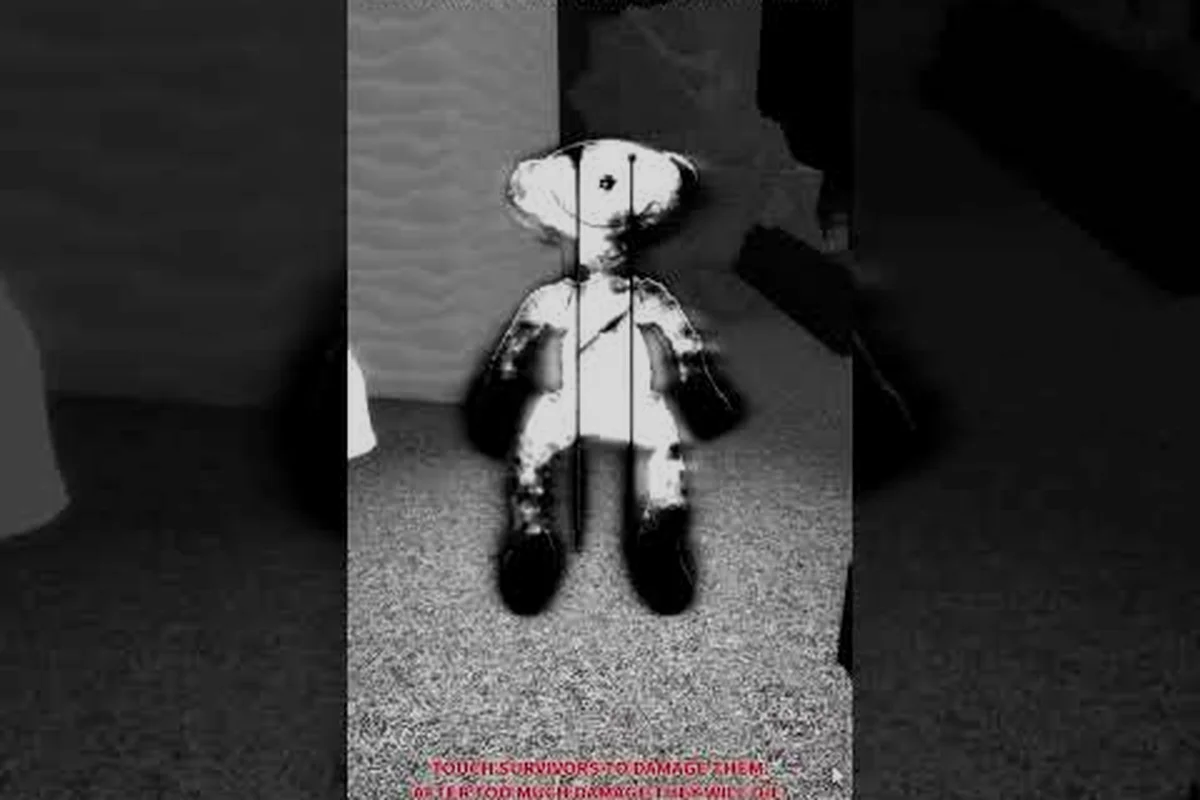
Bear alpha tears before bedtime lore matters because the Deluxe Remake appears to preserve more than a frightening chase: its doors, sound cues, and version differences suggest a buried origin story. The evidence points toward a tragic entity and a disturbing cycle, though several details remain player interpretation.
The bear alpha tears before bedtime lore in brief
Tears Before Bedtime presents a compact horror story through an environment that behaves almost like a character. Players encounter a childlike threat, learn the building’s rhythms, and must survive pursuit while searching for an escape or objective. That simplicity is central to bear alpha horror lore: the game communicates through repetition rather than lengthy exposition.
The Deluxe Remake adds value because it lets viewers examine familiar spaces alongside newly introduced details. A Deluxe Remake gameplay video by Vamp_Boyo documents that version, while an earlier chase recording by klyro provides a useful comparison point. Neither video is an official explanation, so the observations below separate visible evidence from conclusions reported by players.
| Lore element | What the evidence shows | Current interpretation |
|---|---|---|
| The pursuer | A fast, child-associated creature hunts players | A tragic remnant or transformed victim |
| The setting | A dark building with closed routes and changing threats | A bounded memory of a fatal event |
| The title | “Tears Before Bedtime” connects fear with childhood | A bedtime memory turning violent |
| The Deluxe Remake | Repeated spaces, new cues, and altered presentation | A clearer or deliberately altered version of the incident |
| The Alpha name | Marks the earliest accessible state of BEAR | The source version from which later forms descend |
The title’s meaning of alpha is therefore less about a formal character rank than an origin point. In BEAR’s evolving presentation, Alpha appears to be the first and most fundamental version of the experience. If that reading is correct, Tears Before Bedtime may reveal a younger or purer form of the franchise’s central monster.
What “Alpha” may represent
Alpha as first release is the safest interpretation because it directly identifies the version from which later releases appear to derive. A broader reading treats it as the first incarnation of the bear itself: the creature before it becomes the fully developed entity associated with later stories.
These readings can coexist without becoming contradictory. A version label can explain the game’s chronology, while the narrative use of Alpha suggests origin. The evidence does not prove a specific origin date, creator, or laboratory, so claims involving portals, aliens, or artificial reproduction should remain theories until official material directly confirms them. The wider BEAR Alpha lore overview provides useful context for separating the franchise’s recurring signals from the details unique to this story.
Reading the chase as a tragic story
The strongest emotional interpretation of bear alpha where it came from begins with a child’s nightmare. The setting resembles a house, school, or institutional interior, but the route loops and closes around the survivor. Rather than presenting a conventional villain biography, the game turns pursuit into the retelling of an event that may have happened to the entity before its transformation.
The monster’s behavior supports this reading. It chases directly, reacts to nearby survivors, and forces the player into decisions rather than presenting a puzzle with a clean written answer. Repetition of the same conflict can represent a memory being replayed, especially when the survivor eventually approaches an objective connected to what caused the original event.
| Observed feature | Psychological reading | Alternative reading |
|---|---|---|
| Constant pursuit | The entity repeats an unresolved attack | A hostile monster guarding territory |
| Childlike presentation | A transformed or damaged child | A deliberately misleading creature design |
| Claustrophobic routes | The survivor is trapped inside a remembered place | Standard horror map pressure |
| Objective progression | The player reconstructs the incident | A conventional escape objective |
| Final escalation | The memory collapses into immediate danger | A difficulty climax before extraction |
This makes bear alpha final hour story analysis less about naming a villain and more about reconstructing motive. If the child was harmed, the chase may imitate the very event it experienced. If it harmed others, the game may be exploring guilt and repetition. Neither answer changes the observable danger, but it changes how the player reads doors, alarms, and target movement.
The child-monster connection
Community interpretation often describes the pursuer as a corrupted child because of its size, movement, and association with bedtime. That connection is emotionally legible, but visual resemblance alone cannot prove that the creature was once human. A more careful conclusion is that the story associates the threat with childhood and uses the association to make pursuit feel intimate rather than random.
This is where bear alpha what is the bear becomes a question without a clean creature classification. Is the bear a transformed person, a memory made physical, a demonic presence, or a symbol for fear itself? The game’s design can support all of those readings because it shows effects without fully explaining their cause. The most responsible answer is that it is a child-associated horror entity whose exact origin remains unresolved.
Why the setting feels like a memory
The building’s controlled geometry supports the memory reading. A normal house game would offer windows, exits, or familiar landmarks, while this environment repeatedly denies a clean route and funnels survivors into narrow decisions. The Tears Before Bedtime map reference can help players identify connected spaces and compare where objectives lead across the older and remade presentations.
A memory does not need to be realistic. It can distort scale, repeat corridors, and place the same threat near every safe room. That is why the map works as evidence: even without a cutscene explanation, its layout tells the player that the experience is less concerned with geography than remembered danger.
Original release versus the Deluxe Remake
The most important wrinkle in bear alpha two versions discussions is that presentation can change the story’s apparent meaning. A route that felt arbitrary in one build may reveal intent when compared with the remake. Sound placement, timing, lighting, and object interactions can alter whether an event looks accidental, predatory, or mournful.
A verified teaser from Vamp_Boyo focuses specifically on remake material, and player-uploaded ranking videos treat Tears Before Bedtime as its own recognizable scenario. These uploads are evidence that players notice version-specific details, but they are not authoritative patch notes. The evidence supports comparison, not certainty about every changed asset.
| Comparison point | Older version | Deluxe Remake | Lore significance |
|---|---|---|---|
| Overall framing | Primarily a survival chase | A revised presentation with expanded or altered cues | May clarify how the incident is retold |
| Environmental detail | Functional routes and hiding spaces | Additional visual or audio information | Can expose connections between areas |
| Chase presentation | Immediate pursuit under pressure | Remade pacing and presentation | Changes suspense, not necessarily underlying motive |
| Community evidence | Survival clips and route observations | Remake showcases and teaser analysis | Encourages direct comparison |
| Unresolved identity | Creature origin unclear | More clues, but not necessarily a full answer | Supports theories rather than settling them |
The phrase bear alpha two versions can therefore describe both product history and narrative uncertainty. One version may be mechanically different, yet both can point toward the same emotional premise. The remake is valuable because it exposes details that were easy to miss, not because it automatically supplies a canonical answer.
A practical remake comparison method
Compare the same run rather than two unrelated playthroughs. Record the opening route, first chase, major alarm, objective location, and final confrontation. Then compare environmental cues, monster timing, and whether previously decorative objects become interactive. This method separates visual renewal from genuine story changes.
Players should also label each observation by confidence. A visible door change is direct evidence; interpreting that door as a childhood bedroom is speculation; claiming a character died there without support is unsupported. This three-level method helps when analyzing bear alpha tears before bedtime lore because community videos often blend all three categories in a single comment or edit.
What the remake may clarify
The clearest possible clarification would be direct evidence of the creature’s source: an origin scene, a recognizable victim, a document, or a recurring symbol connected to the building. More modest possibilities include revised audio that makes the pursuit resemble a direct quote, or environmental details that connect the objective to the monster’s behavior.
None of those possibilities should be assumed until visible. A polished remake can also preserve ambiguity or intensify it. The Tears Before Bedtime route and puzzle overview should therefore be used as a comparison framework, not as a source of unconfirmed story claims.
The Final Hour story connection and the wider franchise
Tears Before Bedtime is often discussed alongside Final Hour because both use short, high-pressure scenarios and the bear’s pursuit as a narrative force. The comparison is useful, but the bear alpha final hour story should not be treated as a direct continuation unless the games establish a shared location, character, or event.
The broader pattern across BEAR is that the monster becomes more than a pursuer. It can represent fear, grief, guilt, or a fragment of a past event. The Alpha designation strengthens the impression that these scenarios form a chronology. If Tears Before Bedtime reveals a child-linked form or an early state of the creature, then later stories may show what that fragment became.
| Franchise reading | Evidence | Confidence |
|---|---|---|
| Alpha is the earliest version | Naming and version history | High |
| Tears Before Bedtime shows an early or symbolic form of the bear | Chase presentation and child associations | Moderate |
| Every scenario belongs to one continuous story | Recurring monster and horror structure | Plausible |
| Final Hour directly follows Tears Before Bedtime | Community association only | Low without explicit evidence |
| The bear is definitively an alien creature | Larger franchise theories | Not established by this game |
This table matters because BEAR lore attracts confident theories, but a compelling interpretation is not the same as a confirmed fact. The bear alpha where it came from question should be answered in layers. The game places a creature in a psychologically charged environment, associates it with childhood fear, and perhaps presents an early form of the franchise’s monster. Its literal source remains unspecified.
Survival details can still support the story
Lore reading does not require ignoring mechanics. How the bear hunts, how doors function, and where objectives appear all shape the implied narrative. The BEAR Alpha item and door reference provides useful context for noticing which environmental elements are functional and which seem designed to control movement.
For example, a door that blocks the creature while allowing the player to manipulate it suggests a power dynamic. An objective placed near the threat suggests the monster protects something rather than merely hunting at random. Such details do not prove a backstory, but they reveal intended behavior. That behavior can then be compared with the character as child, memory, or avenging spirit interpretations.
Reading sound as emotional evidence
Audio often contributes more than dialogue in a short horror scenario. Footsteps approaching from behind, repeated cries, music that stops during a chase, or a sound linked to a specific location can make the threat feel personal. Community videos and livestreams frequently reveal timing differences that are hard to notice live, which is why recordings remain valuable evidence.
Treat sound as a narrative layer, but distinguish music from dialogue. Atmospheric audio may express the player’s fear, while an explicit voice could carry the monster’s story. A repeated phrase should be transcribed carefully and compared across versions; conclusions based on one noisy recording can be misleading.
A careful theory of the bear’s origin
The most defensible theory is that the bear embodies a violent memory rooted in childhood. The pursuer may have been a child, may represent a child’s memory of danger, or may be a supernatural being that borrows that identity. The title and behavior create this impression, but the game does not conclusively select one biography.
“Bear Alpha” can be understood on three levels: the literal creature encountered in the scenario, the child-linked memory it embodies, and the uncertain question of where that being originated. The child-memory reading is the strongest because the Alpha’s pursuit turns the building into a hostile replay of danger, yet the game provides no decisive identity scene. The evidence table therefore supports “theory” for the bear’s childhood and loop-based origins, “mixed” for a protective objective, and “unsupported here” for another realm or a definitive Tears of the Bedtime explanation.
-
Identity: A child-associated entity in the Alpha scenario.
-
Function: The active pursuer that turns the building into a hostile memory.
-
Origin: Unconfirmed, with a tragic human connection more strongly suggested than a documented location, laboratory, or portal.
This structure keeps the analysis honest because it separates what BEAR visibly establishes from what it only suggests. Bear Alpha’s role as an active pursuer is clear, and the child-linked reading explains why its pursuit turns the building into a hostile memory. However, a childhood origin, a repeated fatal memory, and another-realm theory remain different claims with different evidentiary burdens; none should be presented as settled lore. The table accordingly marks those explanations as “Theory” or “Unsupported here,” while the bear’s possible protective function remains “Mixed.” Treating the creature’s biography as confirmed would erase the uncertainty that gives the Tears of the Bedtime scenario its emotional force.
| Claim | Supporting clue | Missing proof | Best status |
|---|---|---|---|
| The bear was once a child | Child-oriented title and presentation | Direct identity scene | Theory |
| The bear repeats a fatal memory | Loop-like level design and relentless pursuit | Explicit flashback | Theory |
| The bear protects an objective | Consistent interception around objectives | Confirmed patrol logic | Mixed |
| The bear came from another realm | Franchise-wide portal theories | Evidence in this scenario | Unsupported here |
| The Deluxe Remake explains the origin | More visible cues and polish | Official explanation or decisive scene | Unconfirmed |
This is also where bear alpha meaning of alpha can become more than a label. Alpha may mark a primal story state in which the creature’s symbolism has not yet been expanded into later forms. The remake then asks whether clearer production values also mean a clearer narrative answer, even if the answer remains emotionally rather than scientifically defined.
Comparing the plausible explanations
The child-victim theory gains strength from the title and intimate pursuit, while the memory theory gains strength from the setting’s distorted structure. A generic monster explanation fits the pursuit but neglects the strongest emotional cues. Conversely, an elaborate scientific or supernatural explanation demands evidence that this scenario does not visibly provide.
Players should favor the explanation with the strongest chain of support rather than the most dramatic one. That means beginning with visible behavior, connecting it to repeated environmental motifs, and only then identifying a narrative label. The wider survivor strategy reference also helps separate environmental rules from lore, since consistent mechanics are less likely to support every folklore theory.
What is confirmed, suggested, and still invented
Much of the online discussion around BEAR Alpha horror lore blends three levels of certainty: directly shown details, patterns that support interpretation, and inventions added to fill gaps. This distinction matters because the older and Deluxe Remake presentations can establish the chase scenario and child-associated bear imagery, while a tragic origin or memory-loop reading remains interpretive. Treating every inference as confirmed would erase the uncertainty that gives the “Tears Before Bedtime” scenario its atmospheric tension.
Confirmed visual evidence includes the existence of the older and Deluxe Remake presentations, the chase-focused structure, and a scenario centered on a child-associated bear. Strongly suggested evidence includes a tragic origin, memory-loop symbolism, and a possible relationship to the broader Alpha chronology. Unverified claims include a precise death location, a named human victim, laboratory origins, alien involvement, or a confirmed connection to Final Hour.
The verified community sources support the narrower claims. The Roblox DevForum discussion of BEAR-based fan games is relevant to the franchise’s ecosystem and how creators handle its assets, but it is not evidence that a particular in-game creature biography is canonical. Player videos similarly document experiences and interpretations rather than confirming origin details.
| Confidence tier | Examples | Safe wording |
|---|---|---|
| Confirmed | Remake exists; chase scenario exists; bear pursues players | “The footage shows” or “The game presents” |
| Suggested | Child symbolism, tragic memory, early-form interpretation | “This supports the theory that” |
| Speculative | Alien origin, named victim, connected timeline | “Players have proposed” |
| Unverifiable now | Developer intent not shown publicly | “No official explanation confirms this” |
The practical takeaway is simple: analyze the chain, not just the conclusion. If an argument depends on a missing animation, a deleted page, or an assumed hidden room, label it accordingly. This discipline does not weaken the horror lore; it lets the strongest patterns emerge without confusing community creativity for confirmation.
The core takeaway from the Deluxe Remake
The bear alpha tears before bedtime lore appears to center on a chase that is also a memory of harm. Tears Before Bedtime uses childhood imagery, claustrophobic routes, and relentless pursuit to make the bear feel like a tragic presence rather than a conventional monster. The Deluxe Remake gives players a stronger opportunity to compare cues, but comparison alone does not settle the creature’s literal origin.
What remains useful is the overall reading: Alpha likely marks the earliest stage of BEAR’s evolving creature and stories, while Tears Before Bedtime explores an early, emotionally concentrated version of that threat. Its strongest meaning of alpha is therefore not a rank or a simple label. It is a threshold—a fragment of fear that later versions can expand, reinterpret, or connect to a wider history.
Frequently Asked Questions
What is the bear in Tears Before Bedtime?
The bear appears to be a child-associated horror entity that functions as the scenario’s relentless pursuer. Its design and the “Before Bedtime” title suggest a connection to childhood fear or a transformed victim, but no in-game evidence conclusively establishes a human origin. It is safer to call it a tragic or symbolic entity than a confirmed monster with a documented biography.
Does the Deluxe Remake reveal where the bear came from?
Not conclusively. The Deluxe Remake provides additional visual, audio, and environmental clues that can be compared with the earlier version, making the origin seem easier to infer. However, community footage does not prove a literal birthplace or creation method. Unless official material confirms one, the bear’s exact source remains part of the scenario’s deliberate mystery.
Is Tears Before Bedtime connected to Final Hour?
They share the franchise’s chase-based horror language, so players naturally connect them. Nevertheless, a direct narrative link requires a shared character, location, or event. Treat the relationship as thematic unless a specific crossover or explicit story reference establishes that Final Hour continues the events shown in Tears Before Bedtime.
Why is the Alpha version important to the story?
Alpha likely marks BEAR’s earliest accessible state, and it may also represent an early form of the central creature. In Tears Before Bedtime, that could make the scenario feel more primal and intimate than later appearances. The label does not independently confirm every theory, but it gives the bear a possible position in a larger creative chronology.